.png)
How SpaceX’s looming IPO could reorder the private-market leaderboard

SpaceX is reportedly preparing to file IPO paperwork as soon as this week, and the numbers being discussed are so large they barely sound like listing math anymore. Advisers expect the company could try to raise more than $75 billion, which would put the deal in the conversation for one of the biggest public offerings ever.

That headline matters for more than bragging rights. SpaceX is not a hot app with a lucky growth chart. Reuters says it is the largest private space company in the United States, the most active launch provider globally, and the force behind both the reusable Falcon 9 program and the Starlink broadband network. In other words, a public listing would not just float a company. It would put one of the most important pieces of the modern space economy under the daily microscope of public markets.
The timing also says something about how dramatically investor expectations have changed. Reuters reported in December 2023 that a tender offer pushed SpaceX’s value closer to $180 billion. By May 2024, another Reuters report said tender-offer talks implied a value of about $200 billion. In November 2024, Reuters said a December tender offer would value SpaceX at more than $250 billion. Then, in December 2025, Reuters reported a shareholder letter describing a secondary share sale valuing the company at $800 billion and explicitly saying management was preparing for a possible 2026 IPO. Now Reuters says a transaction tied to xAI last month valued SpaceX at $1 trillion. That is not a normal growth arc. That is private-market enthusiasm strapped to a booster.
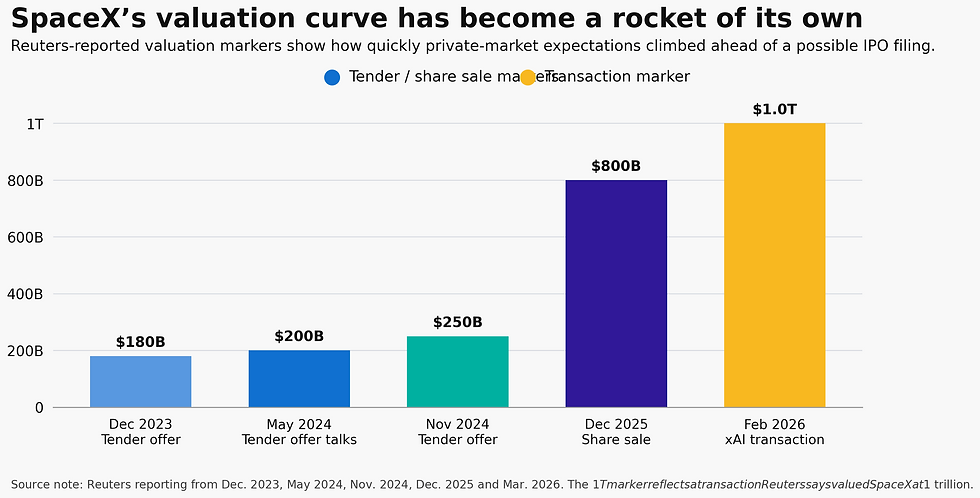
Why has the valuation climbed so violently? Reuters points to three engines: the rapid expansion of Starlink, progress in the Starship program, and the company’s broader pitch around future orbital infrastructure, including data centers in space. The current IPO report says investor enthusiasm for the sector is also being helped by falling launch costs, expanding satellite networks, and rising interest in next-generation space infrastructure. That means the proposed offering is arriving in a market already primed to treat space less like a speculative frontier and more like a commercial platform.
The ripple effects are already visible. Reuters reported that shares of Rocket Lab, Planet Labs, and AST SpaceMobile rose in premarket trading after the IPO report, while Tesla also gained. That reaction hints at the real significance of a SpaceX listing: if it happens, it could pull fresh capital into adjacent aerospace and satellite businesses, reprice private competitors, and make the public market more hospitable to other high-profile listings waiting in the wings. A SpaceX IPO would not just be a company event. It would be a weather event for the whole sector.
There is still a giant asterisk hanging over all of this. Reuters says the filing report came from The Information and could not immediately be independently verified, while the final IPO structure is still being determined. So the safest conclusion is not that SpaceX’s blockbuster listing is guaranteed. It is that the company has traveled far enough, and fast enough, that even the possibility of a filing is moving markets. In a year crowded with AI hype and defense-tech swagger, SpaceX may still be the clearest example of what happens when a private company becomes too large for the private market to contain comfortably.


Comments