.png)
Selena Gomez's Wondermind Faces Fraud Lawsuit After Years of Financial Turmoil

A look at how a celebrity-backed wellness brand went from a $100 million valuation to a federal courtroom.
When Wondermind launched in the spring of 2022, it arrived with the kind of pedigree most startups can only dream of: a co-founder with hundreds of millions of social media followers, backing from one of the most recognizable athletes turned venture capitalists in the world, and a mission — destigmatizing mental health — that was both culturally resonant and, on paper, commercially timely.
Four years later, Wondermind is the subject of a federal fraud lawsuit, its office has reportedly been described by former staff as chaotic and unstable, and the company that once touted itself as "the world's first mental fitness ecosystem" has been reduced to a skeleton crew, if it still operates in any meaningful capacity at all.
The story of Wondermind's rise and collapse is, in many ways, a familiar Silicon Valley cautionary tale: outsized promises, a widening gap between narrative and execution, and investors left holding the bag. But it is also something more specific — a case study in what happens when a celebrity's brand becomes a company's core asset, and that celebrity never quite shows up.
The Pitch
Wondermind was founded in November 2021 by three women: pop star and actress Selena Gomez, her mother Mandy Teefey, and media entrepreneur Daniella Pierson, best known as the founder of the newsletter company The Newsette. The company launched publicly in April 2022 with a thrice-weekly newsletter and a stated ambition to build what it called a "mental fitness ecosystem" — treating psychological wellbeing the way people treat physical exercise, with daily content, product tie-ins, and eventually an app.
Gomez was, by any measure, the company's most valuable asset. She had spoken publicly about her own mental health struggles, including a widely covered emotional breakdown in 2018 and a 2020 disclosure that she had been diagnosed as bipolar. That candor, paired with her massive following and her track record with Rare Beauty — the cosmetics company she built into a business reportedly worth well over a billion dollars — made her an unusually credible face for a mental health brand. Investors were told she would be more than a name attached to the marketing materials: according to a lawsuit filed years later, Gomez had signed on to actively build the company as its head of marketing.
The Serena Ventures Round
Wondermind's defining early moment came in August 2022, not even a year after its public launch. Serena Williams' venture capital firm, Serena Ventures, led a $5 million Series A funding round that valued the young company at $100 million. The round also drew participation from Lightspeed Venture Partners, Sequoia Capital, Curative's Fred Turner, former Allergan CEO Brent Saunders, and Olly co-founder Eric Ryan.
The timing was notable: Williams had just announced, in a Vogue essay, that she was shifting her focus away from professional tennis and toward investing, describing herself as increasingly consumed by reviewing pitch decks for Serena Ventures. Wondermind fit a pattern in the firm's portfolio — women-founded, wellness-adjacent, culturally fluent — and Williams pledged to be personally involved in promoting the brand and helping shape its content.
For Wondermind, the round was as much a credibility signal as it was capital: a marquee investor lending her name to a company whose entire premise rested on trust and authenticity. On paper, Wondermind now had star power, institutional-caliber investors, and a nine-figure valuation less than a year after going public. What it did not yet have, investors would later allege, was much of a functioning business.

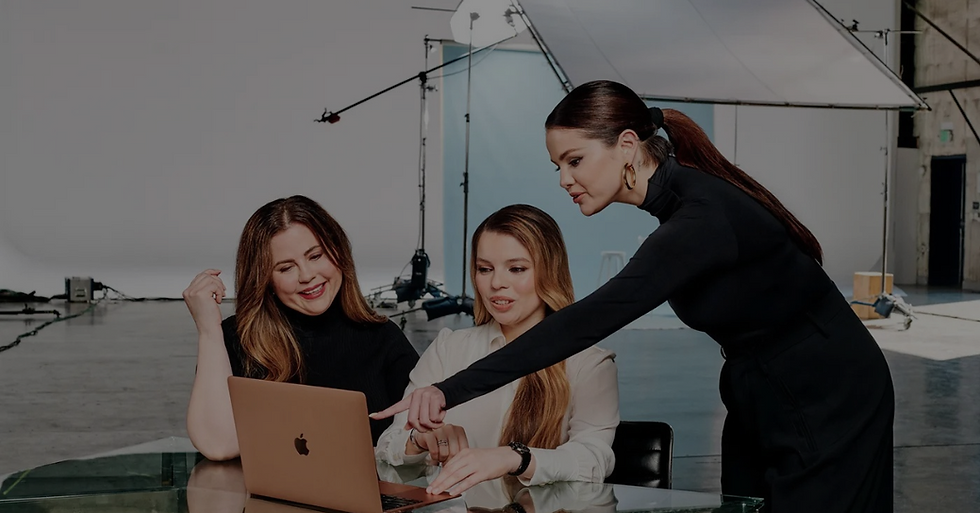
R-L: Selena Gomez, her mother Mandy Teefey, and media entrepreneur Daniella Pierson
The Cracks Appear
For roughly two and a half years after the Serena Ventures round, Wondermind operated largely outside the spotlight, publishing content and building a modest following without generating major headlines. That changed sharply in 2025.
In January 2023, Daniella Pierson departed the company — reportedly amid conflict with Teefey — leaving Teefey as the sole operational leader while Gomez remained largely at arm's length, holding the title of Chief Impact Officer. According to former employees cited in later reporting, Wondermind's financial troubles trace back to this leadership transition.
By the spring of 2025, those troubles became public. Forbes reported in May 2025 that Wondermind, then a roughly 15-person company based in Los Angeles, had stopped paying employees, freelancers and vendors since March of that year. In a recorded all-hands meeting, Teefey reportedly told staff she had taken out a loan against her own home to cover the company's debts.
A company spokesperson told Forbes the startup was working through "growing pains" and promised outstanding payments would be resolved. Two days later, Forbes reported that Wondermind had laid off roughly two-thirds of its staff — nine of its fifteen employees — leaving only four people at the company. Teefey reportedly blamed a delayed investor payment and said the company had been on the verge of closing a Series B round that ultimately fell through.
The full picture of what had been happening inside Wondermind emerged a few months later. In September 2025, New York Magazine's The Cut published a lengthy investigation based on interviews with more than a dozen current and former employees, describing a workplace in a state of what the article characterized as utter disarray.
Former staffers alleged that Teefey exhibited erratic behavior at the office, that some believed she was intoxicated at times, and that her relationship with Pierson had turned openly hostile before Pierson's exit. The piece also reported that Gomez had grown increasingly distant from day-to-day operations amid a strained relationship with her mother, and that Pierson's departure had involved allegations — which she has denied — that she had misappropriated investor funds.
The Lawsuit
The financial and reputational damage culminated on August 13, 2026, when two investment vehicles — Wondermind SRS 44 LLC and Bespoke Wondermind SPV I LLC — filed a federal lawsuit against Gomez, Teefey and Pierson in the U.S. District Court for the District of Delaware. The suit accuses the founders of securities fraud, common-law fraud, and breach of contract, and seeks both rescission of the roughly $1.2 million the plaintiffs say they invested and unspecified damages.
The complaint is unusually detailed about the gap between what investors say they were told and what Wondermind actually delivered. According to the suit, the founders represented that Wondermind would build a consumer app, had secured advertising partnerships worth millions of dollars annually, and had struck institutional deals with companies including JPMorgan Chase and Fidelity — partnerships the plaintiffs allege never existed.
The complaint also cites a May 2022 meeting and subsequent correspondence in which Pierson is alleged to have overstated both her own business track record and the company's traction, at one point suggesting a future valuation north of $4 billion. As recently as March 2025 — weeks before the company missed payroll — the suit alleges Teefey emailed investors describing a forthcoming "huge Summer launch" of the app and talks with NBA leadership about a partnership, even as the company was already failing to pay its staff.
Central to the lawsuit is the claim that Gomez had personally agreed to serve as an active head of marketing, leveraging her platform on the company's behalf, and never did. The plaintiffs argue that for roughly three years, as Wondermind's operations quietly deteriorated, none of its founders, officers or directors disclosed the company's condition to investors — who say they only learned the true state of affairs from the September 2025 Cut article.
Gomez responded forcefully and quickly. Her attorney, Mathew S. Rosengart, called the allegations "completely meritless" and said Gomez would fight them in court. On August 26, 2026, Gomez's legal team filed a motion to dismiss all four claims against her with prejudice, arguing that she was never a board member, never held an equity stake, was never delegated management authority, and had no direct communications with the plaintiffs of the kind the fraud claims would require.
The filing characterized her actual role as that of a paid consultant carrying the honorary title of Chief Impact Officer, with Teefey and Pierson serving as the company's operational co-CEOs. Gomez's lawyers went further, arguing the case against her was so legally deficient that it risked triggering court sanctions against the plaintiffs.
As of early September 2026, the motion to dismiss remains pending before the court, and the broader case against Teefey, Pierson and Wondermind itself continues.
What It Says About Celebrity-Backed Startups
Wondermind's unraveling has become something of a case study for a particular strain of venture skepticism: the celebrity-fronted consumer brand that raises capital on the strength of a founder's cultural cachet rather than a proven operating model. It is not, on its own, an indictment of celebrity involvement in startups — Gomez's own Rare Beauty is frequently cited as a counterexample of that model working. But the contrast between the two companies is instructive.
Rare Beauty had a defined product, a retail distribution strategy, and, by most accounts, sustained founder engagement. Wondermind, according to the allegations now before a federal court, had a compelling story and comparatively little else — and the person whose name gave the company its market value was, investors say, never really in the building.
For Serena Ventures, the episode is a reminder of the reputational exposure that comes with lead-investor status in founder-driven consumer bets: the firm's name and Williams' personal credibility were used to help validate the round to later investors and the public, even though Serena Ventures itself is not named as a defendant in the current lawsuit.
For the broader wellness and creator-economy investing world, Wondermind's collapse lands as a cautionary marker at a moment when "founder-market fit" is increasingly measured in follower counts rather than operating experience.
Timeline: From the Serena Ventures Investment to the Federal Lawsuit
November 2021 — Selena Gomez, her mother Mandy Teefey, and entrepreneur Daniella Pierson co-found Wondermind.
April 2022 — Wondermind launches publicly with a thrice-weekly newsletter, positioning itself as a "mental fitness ecosystem."
August 2022 — Serena Ventures, the VC firm founded by Serena Williams, leads a $5 million Series A round, valuing Wondermind at $100 million. Lightspeed Venture Partners, Sequoia Capital, and individual investors including Brent Saunders and Eric Ryan also participate.
May 2022 – mid-2022 — According to the later-filed lawsuit, Pierson allegedly tells investors the company has secured partnerships with JPMorgan Chase and Fidelity and projects millions in annual ad revenue — claims investors say turned out to be false.
January 2023 — Daniella Pierson exits Wondermind, reportedly following internal conflict with Teefey; Teefey becomes the company's sole operational leader.
March 9, 2025 — Per the lawsuit, Teefey emails investors touting an upcoming major app launch and talks with the NBA, even as the company is already behind on payroll.
May 10, 2025 — Forbes reports Wondermind has failed to pay employees, freelancers and vendors since March; Teefey tells staff she took out a loan against her home to cover debts.
May 12, 2025 — Forbes reports Wondermind has laid off roughly two-thirds of its staff — nine of fifteen employees — leaving four people at the company.
September 3, 2025 — The Cut publishes a detailed investigation, based on interviews with more than a dozen current and former employees, describing a company in disarray, alleging erratic behavior by Teefey and describing Gomez's growing distance from the business. The lawsuit later identifies this as the moment investors first learned the company's true condition.
August 13, 2026 — Wondermind SRS 44 LLC and Bespoke Wondermind SPV I LLC file a federal lawsuit in the District of Delaware against Gomez, Teefey and Pierson, alleging securities fraud, common-law fraud and breach of contract tied to roughly $1.2 million in investments.
August 15, 2026 — Gomez's attorney publicly calls the allegations "completely meritless" and announces plans to seek dismissal.
August 26–27, 2026 — Gomez's legal team files a motion to dismiss all claims against her with prejudice, arguing she held no board seat, no equity stake and no management role, and raising the possibility of sanctions against the plaintiffs.
Early September 2026 — The motion to dismiss remains pending; litigation against Teefey, Pierson and Wondermind continues.
This article is based on public reporting from Forbes, NBC News, The Hollywood Reporter, Variety, Rolling Stone, TMZ, The Cut, and court filings in the District of Delaware, among other outlets.


Comments