.png)
Tech Giants Join Forces to Build Next-Gen Low-Carbon Data Centers

The physical constraint hitting the expansion of artificial intelligence is no longer chip availability—it is the electric grid. On June 5, 2026, four of the world's largest hyperscalers—Amazon, Google, Meta, and Microsoft—made an unprecedented collaborative pivot. Through a centralized program spearheaded by nonprofit investor Elemental Impact, the tech giants launched the Data Center Innovation Initiative to collectively fund early-stage cleantech companies.
The shared venture capital alliance will directly back clean technology startups developing liquid cooling mechanisms, low-carbon structural building materials, and long-duration energy storage. Individual allocations will range between $500,000 and $5 million per project, running through the end of 2027.
By working together, these traditionally fierce cloud rivals hope to quickly build out a brand-new supply chain of energy-efficient physical components. This shared infrastructure is vital to support their massive, combined $700 billion capital expenditure plans without destabilizing local energy grids.
The Massive Surge in AI Utility Load
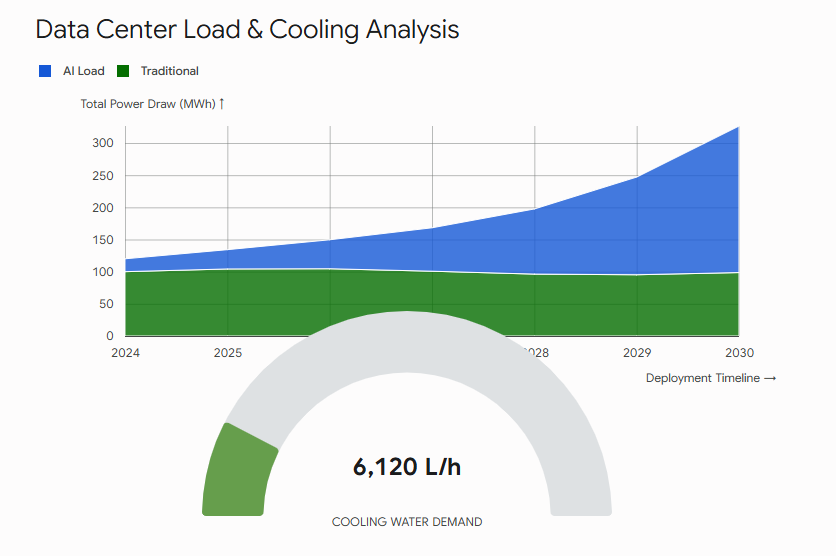
The driving force behind this corporate alliance is a stark reality: modern generative AI workloads require exponentially more electrical power than standard cloud computing tasks:
Skyrocketing Projections: Data from the National Electrical Manufacturers Association (NEMA) projects that data center electricity demand will surge by a staggering 300% over the next decade.
The Cooling Challenge: High-density tensor processing units (TPUs) generate immense heat, overwhelming standard forced-air cooling systems. Moving to direct-to-chip liquid cooling loops requires completely redesigning facility piping.
The Carbon Footprint of Concrete: The physical shells of these computer warehouses require massive quantities of traditional structural cement, which is a major contributor to global carbon dioxide emissions. The initiative is actively looking to swap this out for novel, low-carbon alternative materials.
The analytical dashboard below illustrates the dramatic shift in raw power consumption metrics as enterprise workloads transition from classic web searches to advanced multi-modal AI generation.
Moving Past the "Single-Buyer" Strategy
Historically, hyperscalers operated on highly isolated, proprietary infrastructure tracks, using custom server topologies as a distinct competitive advantage. However, the sheer scale of the coming energy crunch has made that siloed approach unviable.
By utilizing Elemental Impact's joint funding framework, the companies can de-risk early-stage deep-tech bets. Once a startup successfully proves out a low-carbon building concrete or an ultra-efficient liquid manifold system, all four tech giants can immediately integrate the technology across their global facility footprints, generating instant economy-of-scale savings.
The Computing Efficiency Evolution
Operational Metric | Legacy Data Center Architecture | Next-Gen Low-Carbon Cluster |
Primary Cooling Method | High-volume forced air via industrial chillers. | Direct-to-Chip Liquid Cooling and phase-change fluids. |
Structural Frame Profile | Standard high-emission structural steel and concrete. | Subsidized Low-Carbon Cement and recycled composites. |
Grid Integration | Passive, intermittent draw from local public utilities. | Long-Duration Battery Storage and localized microgrids. |
The transition to direct-to-chip liquid cooling setups can lower facility power usage effectiveness (PUE) ratios down close to an optimal 1.1, saving billions of kilowatt-hours annually.
For additional perspectives on these cross-industry initiatives, read the primary coverage via the Climate Action low-carbon data center ledger detailing the Elemental Impact allocations, view shifting regional market responses on the Bloomberg businessweek daily financial wrap-up, or trace broader macroeconomic credit adjustments on the Goodwin technology venture financing review.


Comments