.png)
Are You Building an Insurance Agency or Just Hiring Bodies? The Sales Leader's Complete Guide to Recruiting and Training Health and Life Insurance Agents in 2026

Most insurance agency leaders make the same expensive mistake when they start scaling their team. They hire for availability rather than aptitude. They recruit warm bodies to fill seats, hand them a product sheet and a carrier list, and measure success by whether those agents show up on Monday. Six weeks later the attrition starts. Within ninety days, half the team is gone — and the agency leader is back at the beginning, advertising on Indeed, wondering why the same cycle keeps repeating.
Building a high-performing health and life insurance agency is not a recruiting problem. It is a system problem. The leaders who break out of the churn cycle are the ones who build a pipeline of the right candidates, get them licensed and contracted with precision, train them on a structured sales methodology, and equip them with the right tools for every stage of the client engagement — from first call to policy submission. Here is the complete playbook.
Who to Look For: The Profile of an Agent Who Actually Lasts
The insurance industry's attrition problem is legendary and largely self-inflicted. Most agencies recruit without a defined profile, hope for the best, and attribute failure to the market rather than the hire. The agencies with the lowest attrition and the highest per-agent production share a common discipline: they recruit against a specific behavioral and motivational profile rather than a resume.
According to Vouch's Insurance Recruiting Guide, companies that invest in employer branding and a defined candidate profile see 50% more qualified applicants — with the most successful insurance agency recruiters screening first for intrinsic motivation, communication clarity, and coachability rather than prior industry experience, since prior experience often comes with deeply embedded habits that are harder to retrain than building from scratch.
The profile that predicts success in health and life insurance sales in 2026 is specific. You are looking for candidates with a genuine service orientation — people who are motivated by the outcome they create for the client, not just the commission check. You are looking for people with demonstrated resilience in previous roles — sales experience in any field, customer-facing experience in high-pressure environments, military background, or competitive athletic history all correlate with the persistence that insurance sales requires. And you are looking for people who are coachable: who respond to feedback with curiosity rather than defensiveness, who ask questions rather than defending assumptions, and who have a documented track record of improving in previous roles.
The profile you want to avoid is equally specific. The candidate who is primarily motivated by the income ceiling and has no genuine interest in health and financial planning will rarely survive the compliance training, the licensing exam, and the first ninety days of prospecting. The candidate who has been in insurance before but left multiple agencies after short tenures deserves careful scrutiny — not automatic rejection, but direct conversation about what happened and what is different this time.
And the candidate who cannot articulate why health and life insurance matters to real families — beyond the commission — is telling you something important about how they will approach the client relationship. Practical sourcing channels that outperform job boards for insurance agent recruiting include LinkedIn talent search, referrals from your best existing agents, Indeed's insurance-specific job postings, and outreach to people currently in adjacent roles — financial advisors, mortgage brokers, real estate agents, and benefits administrators — who already understand financial conversations and have established trust with potential clients.
Licensing: The First Gauntlet — And How to Streamline It
Pre-licensing is where many recruits fall out of the pipeline before they ever make a sale. Agency leaders who understand this design their licensing support to maximize completion rates rather than simply pointing recruits toward a state education provider and wishing them luck.
The licensing requirements for health and life insurance vary by state — most require between forty and sixty hours of pre-licensing education, a passing score on the state exam, a background check, and a licensing fee. The process typically takes four to eight weeks from start to finish for a motivated candidate.
For pre-licensing education, ExamFX and Kaplan Financial Education are the two most widely used platforms — both offering state-specific courses, practice exams, and study tools that significantly improve first-attempt pass rates. Agency leaders who fund the pre-licensing course for recruits reduce attrition at this stage dramatically and signal a commitment to the agent's success that paid-for-by-yourself licensing never does.
According to EMG Brokerage's Insurance Agent Licensing Guide, agents can typically complete the full licensing process in four to eight weeks with proper support — and agencies that provide pre-licensing resources, course guidance, and exam preparation support significantly reduce the drop-out rate at this stage, ensuring that the recruits who make it through are genuinely committed to the business.
For agencies operating across multiple states, non-resident licensing is an essential tool for expanding production geography without requiring physical presence. Most states offer reciprocal licensing that allows an agent licensed in their home state to obtain non-resident licenses with simplified applications. Sircon and NIPR are the two platforms through which non-resident license applications are submitted, managed, and renewed — and building familiarity with both into your onboarding process saves significant administrative time at scale.
Carrier Contracting: Getting Agents Appointed Fast
Once licensed, agents need carrier appointments before they can submit business. This is where many small agencies create unnecessary delays — handling contracting manually, email by email, carrier by carrier — when platform solutions exist that compress the timeline from weeks to days.
For ACA and marketplace health plans, HealthSherpa is the largest ACA agent enrollment platform in the country and the only platform approved by CMS to offer Enhanced Direct Enrollment — allowing agents to process applications, submit follow-ups, and track status without ever leaving the platform, with a branded enrollment website included that gives clients the option to self-enroll using the agent's unique NPN link.
Getting an agent set up on HealthSherpa requires completing FFM certification for the current plan year, selecting and getting appointed with ACA carriers in the states where the agent is licensed, creating a HealthSherpa account and entering the agency join code, integrating their FFM account with the platform, and enabling Enhanced Direct Enrollment — a process that can be completed in a single focused day once licensing is in place.
For life insurance and ancillary product contracting, AgencyBloc and Surancebay's SureLC are both strong platforms for managing contracting, appointments, and license verification at scale — allowing agency leaders to track which agents are appointed with which carriers in which states from a single dashboard rather than chasing down paperwork across individual carrier portals.
For Medicare Advantage and Medicare Supplement contracting, agents must complete individual carrier certifications annually — AHIP certification is the industry standard prerequisite, and most major carriers accept it in lieu of their own proprietary certification modules. Building AHIP certification into the onboarding timeline for any agent selling into the senior market eliminates a common delay that costs agencies production during the enrollment season.

Sales Training: Building the Foundation Before the First Call
The training failure that drives most insurance agency attrition is not product knowledge failure. It is sales process failure. Agents who know the products thoroughly but cannot run a client conversation — cannot build rapport quickly, ask discovery questions effectively, handle objections confidently, or close professionally — will fail regardless of how well they understand the policy details.
A structured sales training curriculum for new insurance agents should cover four competency areas in a defined sequence.
Needs analysis and discovery comes first. Agents who lead with product — quoting before they understand the client's situation, health history, budget, and goals — are leaving money on the table and damaging the relationship before it starts. Every new agent should be drilled in the discovery conversation until asking the right questions is instinctive before presenting a single plan or quote.
Product knowledge follows discovery — not precedes it. When agents understand what the client needs first, product training is absorbed with context rather than memorized in isolation. The coverage categories that every health and life agent needs to own include ACA marketplace plans, Medicare Advantage and Medicare Supplement, term and whole life, final expense, and critical illness and disability coverage as ancillary lines.
Objection handling is the skill that separates producing agents from struggling ones. Price objections, spousal objections, existing coverage objections, and timing objections each have specific, practiced response frameworks that can be taught, drilled, and refined. Role-play is not optional — agents who have heard every major objection a hundred times in training respond to them in live client conversations with the confidence that produces conversions.
Compliance training is non-negotiable and ongoing. CMS compliance requirements for ACA agents, state insurance department regulations, and carrier-specific guidelines change annually. Building a compliance update cadence into monthly team training ensures your agents stay current — and protects the agency from the regulatory exposure that comes from agents who are selling out of compliance.
Insurance Agency Agent Production Benchmarks — Visualized
Here is how the key performance metrics compare between insurance agencies operating without a structured recruiting and training system and those running a defined agent development program:
The Tools Stack That Powers a High-Performing Insurance Agency
The right technology infrastructure turns a good agent into a great one by eliminating administrative friction, systematizing follow-up, and ensuring that every client interaction happens in context — with the full picture of that client's situation available in real time.
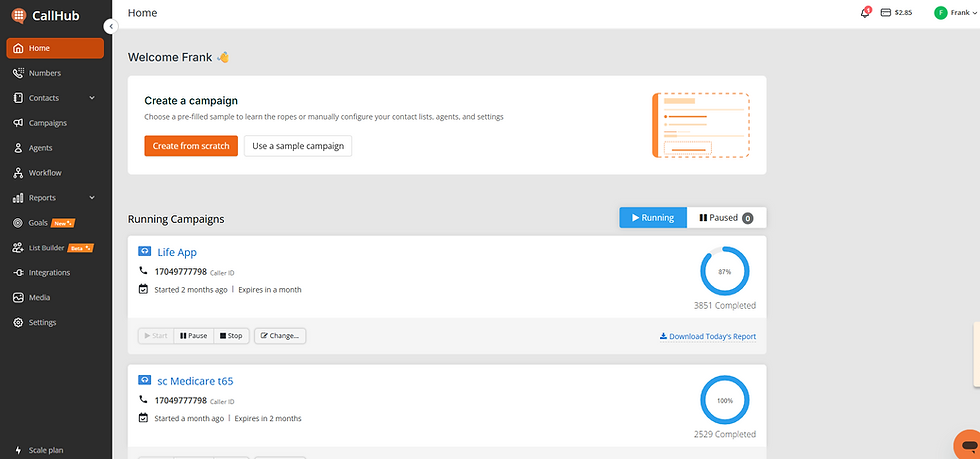
Dialing and outreach is the engine room of any insurance agency. CallHub is a widely used power dialer and SMS platform built specifically for high-volume outbound operations — offering predictive dialing, voicemail drop, call recording, and CRM integration that allows agents to work through large prospect lists without manual dialing friction. For agencies prospecting into cold lead lists, pairing CallHub with verified, accurate consumer contact data from Salesfully ensures that the list quality feeding the dialer is high enough to protect agent time and protect TCPA compliance — because a dialer running against a bad list creates legal exposure as fast as it creates pipeline.
ACA enrollment belongs entirely in HealthSherpa. Its Enhanced Direct Enrollment capability, subsidy calculation tools, client intake link sharing, and branded enrollment website make it the operational center of any ACA-focused agency. Agency leaders can monitor their entire team's enrollment activity, track client pipeline, and manage renewals from a single dashboard — with the platform's renewal factor tools specifically designed to identify clients who need proactive re-engagement for the upcoming plan year.
CRM and policy management for insurance agencies is best handled by insurance-specific platforms rather than generic sales CRMs. AgencyBloc is purpose-built for health and life agencies — managing clients, policies, commissions, licensing, and carrier contracting in a single system. For smaller agencies not yet ready for a full AgencyBloc implementation, HubSpot's free CRM provides sufficient pipeline tracking and follow-up automation to manage a growing book of business without the complexity.
E-signatures and applications for life insurance are dramatically streamlined by iPipeline — the industry standard for electronic application submission across most major life carriers — eliminating paper applications and reducing new business submission time from days to minutes.
The Retention Strategy: Keeping the Agents You Built
Recruiting and training a great agent only to lose them to a competitor or burnout twelve months later is one of the most expensive outcomes in the insurance business. The agencies with the strongest retention are not necessarily the ones paying the highest commission splits — they are the ones providing the clearest career pathway, the most consistent coaching, and the best technology infrastructure.
According to Redbird Agents' Insurance Recruiting Research, the most effective retention strategy for insurance agencies in 2026 is cultural fit combined with ongoing development — agents who feel genuinely invested in by their agency leader, who have a clear understanding of how their income will grow as their book of business grows, and who receive consistent coaching and accountability stay significantly longer than those operating in a sink-or-swim environment regardless of commission level.
Monthly one-on-one pipeline reviews, weekly team training calls that combine product updates with sales skill development, and a clear commission advancement structure tied to production milestones are the three retention mechanisms that cost the least and produce the most loyalty.
Pair those with the right tools — HealthSherpa for ACA enrollment, CallHub for outbound dialing, AgencyBloc for CRM and commission tracking, and verified lead data from Salesfully for prospecting — and you are building an environment where a motivated agent has everything they need to succeed without friction.


This post hits the nail right on the head because way too many sales leaders treat agency building like a revolving door instead of actual team development. If you are just cycling through warm bodies to hit short-term recruitment numbers, your agency is never going to achieve real, sustainable growth. Building a powerhouse health and life insurance agency requires a deliberate focus on deep training, clear expectations, and structured mentorship rather than throwing random agents to the wolves and hoping something sticks. When new producers come on board—whether they are tackling complex health products, life policies, or even cross-selling property lines like auto insurance—they need a foolproof roadmap, reliable systems, and genuine support to survive the initial learning curve. Shifting away from…
Great post! Transitioning from "filling seats" to actually building a high-performing agency is the exact shift leaders need in 2026. Recruiting is just the first step; if you aren’t pairing that talent with robust insurance workflow automation, you’re just creating a bottleneck, not a business. Manual tasks kill momentum and burn out new hires before they even hit their stride. By automating the grunt work, you allow your agents to focus on what actually drives revenue: client relationships. Building a scalable agency requires this balance of quality human talent and smart tech. It’s the only way to win.